
Writers’ Paris: 5 legendary cafés where literature is still being written
Category : Hotel Corona Rodier
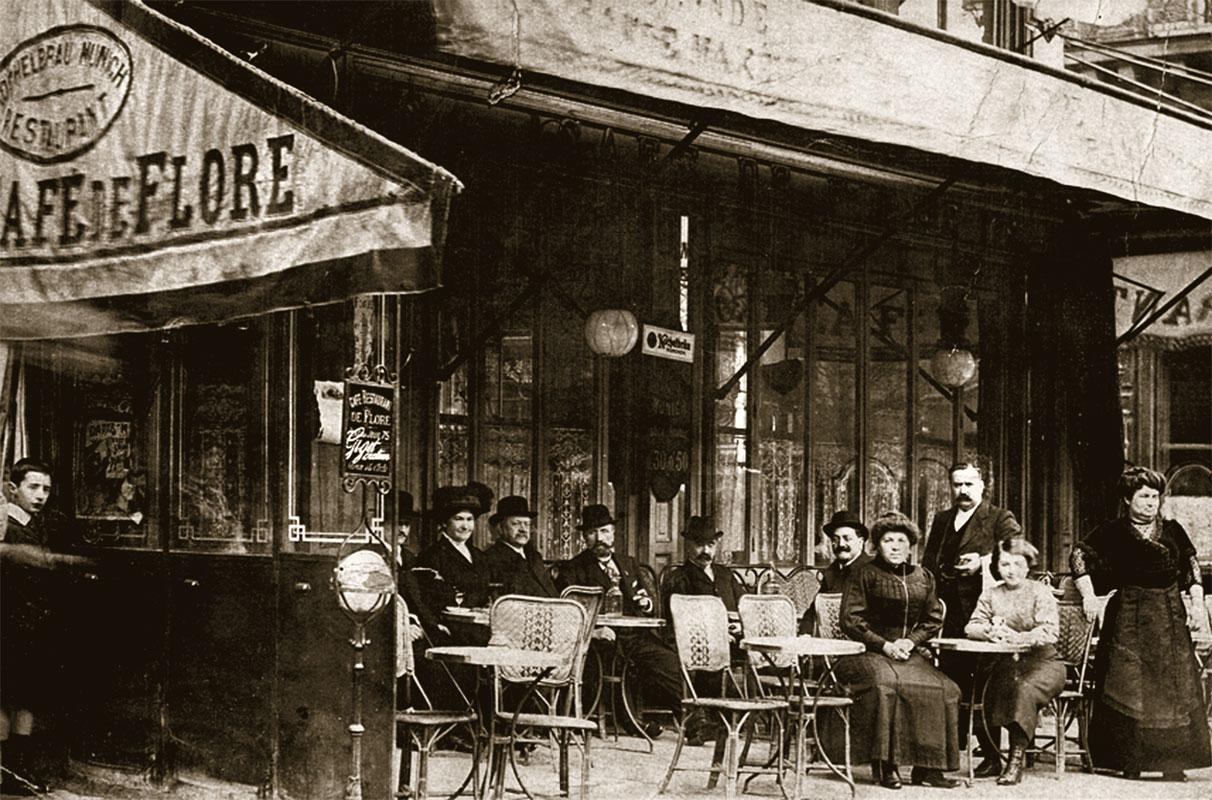
For centuries, Parisian cafés have been more than just places to have a drink; they have served as extensions of the writer’s study. In these establishments, people have put the world to rights, drafted manifestos and proofread manuscripts between sips of café crème.
Here is a journey to the heart of five venues where the spirit of the great authors still permeates the wood panelling.
1. Le Café de Flore: The Headquarters of Existentialism

Jean-Paul Sartre and Simone de Beauvoir in front of the statue of Balzac (erected in 1939), Boulevard Raspail, Paris. Copyright holder: Archives Gallimard, Paris; Archives Gallimard no longer exists (Public Domain)
Located on the corner of Boulevard Saint-Germain, Le Flore is undoubtedly the most famous café in the world. During the Occupation, it became a refuge for Jean-Paul Sartre and Simone de Beauvoir.
- Anecdote: The couple would settle in there as early as 9 o’clock in the morning. Sartre wrote: ‘We would settle in completely: from 9 o’clock in the morning until midday, we would work there; we would go for lunch; at 2 o’clock we would return and chat with friends we met there until 8 o’clock. ”
Today: You can still bump into the cream of Paris’s literary scene there, and the prestigious Prix de Flore is awarded there every year in November.
2. Les Deux Magots: The Long-standing Rival

Photograph of Marcel Proust by Otto Wegener (1849–1924). On the photographer’s card, dimensions 14.2 x 10.2 cm. From a series of several poses taken in 1895; the bottom of the card is not shown. (Public Domain)
Directly opposite Le Flore, Les Deux Magots was once a haunt of the cream of the Symbolist movement before becoming a regular haunt of Albert Camus and Ernest Hemingway.
- Fun fact: It was here, in 1922, that James Joyce and Marcel Proust met for the one and only time. Legend has it that the conversation was a let-down, with the two literary giants talking only about their respective health problems.
The atmosphere: Its famous Chinese statues (the ‘magots’) still watch over the rooms where the secrets of publishing are whispered.
3. La Closerie des Lilas: The Montparnasse Lighthouse

Oscar Wilde (1854–1900) on 23 May 1889. Photograph by W. and D. Downey. (Public domain)
At the far end of the Left Bank, this shaded café-brasserie was a favourite haunt of the ‘Lost Generation’.
- Fun fact: It was at these marble tables that Ernest Hemingway wrote much of his novel *The Sun Also Rises*. A small brass plaque on the counter marks his favourite spot.
The style: More intimate and leafy, it’s the ideal spot to imagine Paul Verlaine playing chess or Oscar Wilde fleeing his creditors.
4. Le Procope: The Cradle of the Enlightenment

Photo : Amandine Goetz
Founded in 1686, it is the oldest café in Paris. Here, people talk not only about literature, but also about revolution.
- Fun fact: It is said that Voltaire used to drink up to 40 cups of a mixture of coffee and chocolate a day to stimulate his mind. Diderot is said to have drafted sections of the Encyclopédie between games of billiards.
Not to be missed: Napoleon’s hat, left as collateral for a coffee debt, is still on display there.
5. The Rosebud: The Elegance of Shadow

Marguerite Duras in 1960. Passport photo (Sacem). (Public domain)
Less touristy and with a livelier nightlife, this bar in the Montparnasse district was Marguerite Duras’s favourite haunt.
- A little-known fact: Duras was a regular here, finding in the venue’s hushed, jazzy atmosphere an echo of her own melancholy. It’s the sort of place where you go to sip a whisky whilst listening to the silence of unspoken words.
Why go: To escape the crowds and rediscover the Paris known only to the initiated.
Although the giants are no longer with us, the tradition lives on. Today, new venues such as the Used Book Café (in the Marais) or La Belle Hortense combine the pleasures of wine and reading, proving that Paris remains, against all odds, a celebration of the mind.
Featured image: Le Café de Flore around 1900. (Public domain)